
SEO Content: How to Write Content That Ranks on Google in 2026

Updated: Apr 28

60% of Google searches now end without anyone clicking a single link. That sounds scary , but here is the good news. The other 40% still send millions of people to websites every single day. And the number one result still gets around 34% of all those clicks. SEO content, content written to rank on Google, is still one of the most powerful ways to get found online.
The problem is that a lot of people are writing content the wrong way. They stuff in keywords, guess at what Google wants, and wonder why nothing ranks. Google has changed a lot in the last few years, and in 2026, it rewards content that is genuinely helpful, well-structured, and written by someone who actually knows what they are talking about.
The good news is that writing content Google loves is not complicated once you understand the rules. You do not need to be a tech expert. You just need to know what to write, how to lay it out, and how to show Google you are a trustworthy source.
This guide will walk you through exactly how to do all of that,from picking the right keywords to structuring your page, building trust with Google, and refreshing old content that has stopped performing.
What Is SEO Content?
SEO content is any piece of writing, a blog post, a guide, a product page, a FAQ — that is created with the goal of showing up in Google search results. It is not just about putting keywords in your text. It is about writing something so useful and clear that Google decides it is the best answer to give someone who searched for that topic.
Think of Google as a librarian. When someone searches for something, the librarian wants to point them to the most helpful, most trustworthy book on the shelf. Your content is your book. The better it answers the question, the more clearly it is written, and the more credible the author looks, the more likely the librarian is to recommend it.
Search intent is the most important concept to understand here. Every search has a purpose behind it. Someone searching "how to bake bread" wants a step-by-step guide. Someone searching "best bread maker" wants a comparison. Someone searching "buy bread maker" wants to buy one. If your content does not match what the searcher actually wants, it will not rank, no matter how well written it is.
"Google is not trying to rank the best content. It is trying to rank the most helpful content for that specific search." — John Mueller, Google Search Advocate
Good SEO content serves two audiences at once: the person reading it and Google crawling it. For the reader, it answers their question clearly and completely. For Google, it signals authority through structure, links, and expertise signals. When both are done well, ranking follows naturally.
Google processes billions of searches every day. 70% of those searches contain three or more words, meaning people are looking for specific, detailed answers, not generic overviews. That is good news for anyone willing to write content that goes deep on a topic. Moz's Beginner's Guide to SEO is an excellent free resource if you want to build on the fundamentals covered here.
How SEO Content Works
SEO content works by sending signals to Google that tell it your page is the right result for a specific search. There are five main signal types , and understanding each one helps you write content that ticks every box.
Signal 1: Matching What the Reader Actually Wants
Search intent is Google's top priority. Before you write a single word, search your target keyword on Google and look at what is already ranking. Are the top results blog posts, product pages, videos, or something else? That tells you what type of content Google thinks searchers want for that query. Write the same type, not a different one.
If the top results are all "10 best" listicles, Google has decided searchers want a comparison list. Writing a 3,000-word essay on the history of the topic will not rank, no matter how good it is. Match the format of what is already winning.
Signal 2: Covering the Topic Properly
Content depth tells Google how seriously you have covered a topic. A page that only scratches the surface will lose to a page that answers the main question and every sensible follow-up question. You do not need to write the longest article possible, you need to write the most complete one.
A simple test: read the top three ranking pages for your keyword. Write down every question they answer. Then add the questions they missed. Your page should answer everything they covered, plus those gaps. That is how you give Google a reason to prefer your page over theirs.
Signal 3: Structure Google Can Follow
Page structure helps Google understand what your page is about and which parts matter most. Use one H1 heading (your page title). Use H2 headings for your main sections. Use H3 headings for sub-points within those sections. Keep paragraphs short, two to three sentences maximum. Use your target keyword in the H1, in at least one H2, and naturally throughout the body.
Internal links, links to other pages on your own website, help Google understand how your content connects. They also keep readers on your site longer. Aim for two to four internal links per article, pointing to related pages that are genuinely useful to the reader.
Signal 4: Showing Google You Know What You Are Talking About
E-E-A-T stands for Experience, Expertise, Authoritativeness, and Trustworthiness. It is Google's framework for deciding whether a source is credible. Practically, this means: put a real author name on your content, include a short bio that explains why they are qualified to write about this topic, cite credible external sources, and include original insights or real experience — not just rephrased information from other websites.
You do not need to be a world expert to show E-E-A-T. A local plumber writing about common boiler problems has genuine experience that a generic content writer does not. That first-hand knowledge is exactly what Google is looking for.
Signal 5: Technical Basics
Meta descriptions are the short summaries that appear under your page title in Google results. They do not directly affect rankings, but a clear, compelling meta description improves the chance someone clicks your result. Keep it under 155 characters, include your keyword, and make it clear what the reader will get from the page.
Page speed, mobile friendliness, and clean formatting also matter. A slow page that is hard to read on a phone will lose traffic even if it ranks — because Google measures how long people stay on your page after clicking. If they leave immediately, Google takes that as a sign your content was not helpful.
How to Write SEO Content: Step by Step
Here is the exact process, from a blank page to a published post that has a real chance of ranking. Follow these steps in order every time you write a new piece.
Step | What to Do and Why |
Pick a keyword people actually search | Start by finding out what your audience types into Google. Use Google Search Console to see what searches are already bringing people to your site. Use Ahrefs or Semrush to find new keyword ideas — look for terms with decent search volume but not so much competition that a new page has no chance. Start with long-tail keywords (three or more words) — they are easier to rank for and attract more specific, ready-to-act readers. |
Check search intent before writing anything | Search your keyword on Google before you write a single word. Look at the top five results. What type of content are they — blog posts, product pages, listicles, guides? What questions do they answer? How long are they? This research tells you exactly what Google expects for that keyword. Write to match that format and depth — not what you feel like writing. |
Write a clear headline and structure first | Write your H1 title with the exact keyword in it. Then plan your H2 headings before you write the body. Each H2 should be a key question or subtopic your reader needs answered. This gives both you and Google a clear map of the page. Write the outline in Google Docs so it is easy to share with a reviewer before you spend time writing the full piece. |
Write for the reader first, Google second | Write in plain, clear language that your reader can understand. Use short sentences. Use everyday words. Explain jargon when you have to use it. Include your keyword naturally in the first paragraph, in at least one H2, and a few times in the body — but never force it. A sentence that reads unnaturally because of a keyword is worse for SEO than a sentence that reads well without it. |
Show your expertise with original insight | Add something only you can add: a real example from your own experience, a stat you have seen in your work, a common mistake you have watched clients make, or a point of view that differs from the generic advice. This is what E-E-A-T looks like in practice. It does not have to be long — one or two original observations per article is enough to make your content stand out from the recycled versions of the same post that fill page one. |
Use Surfer SEO or ChatGPT to check coverage | Once your first draft is written, run it through Surfer SEO's Content Editor to check whether you have covered the topic as thoroughly as the top-ranking pages. Surfer shows you which related terms and entities you are missing. Alternatively, paste your draft into ChatGPT and ask it to identify any important subtopics or questions you have not addressed. Fill the gaps before publishing. |
Add a meta description, internal links, and schema | Write a meta description of under 155 characters that includes your keyword and clearly tells the reader what they will get from the page. Add two to four internal links to related pages on your site. If your page has FAQs, add FAQ schema using Yoast SEO or Rank Math — this takes two minutes and can earn you extra visibility in search results. Validate your schema using Google's Rich Results Test before publishing. |
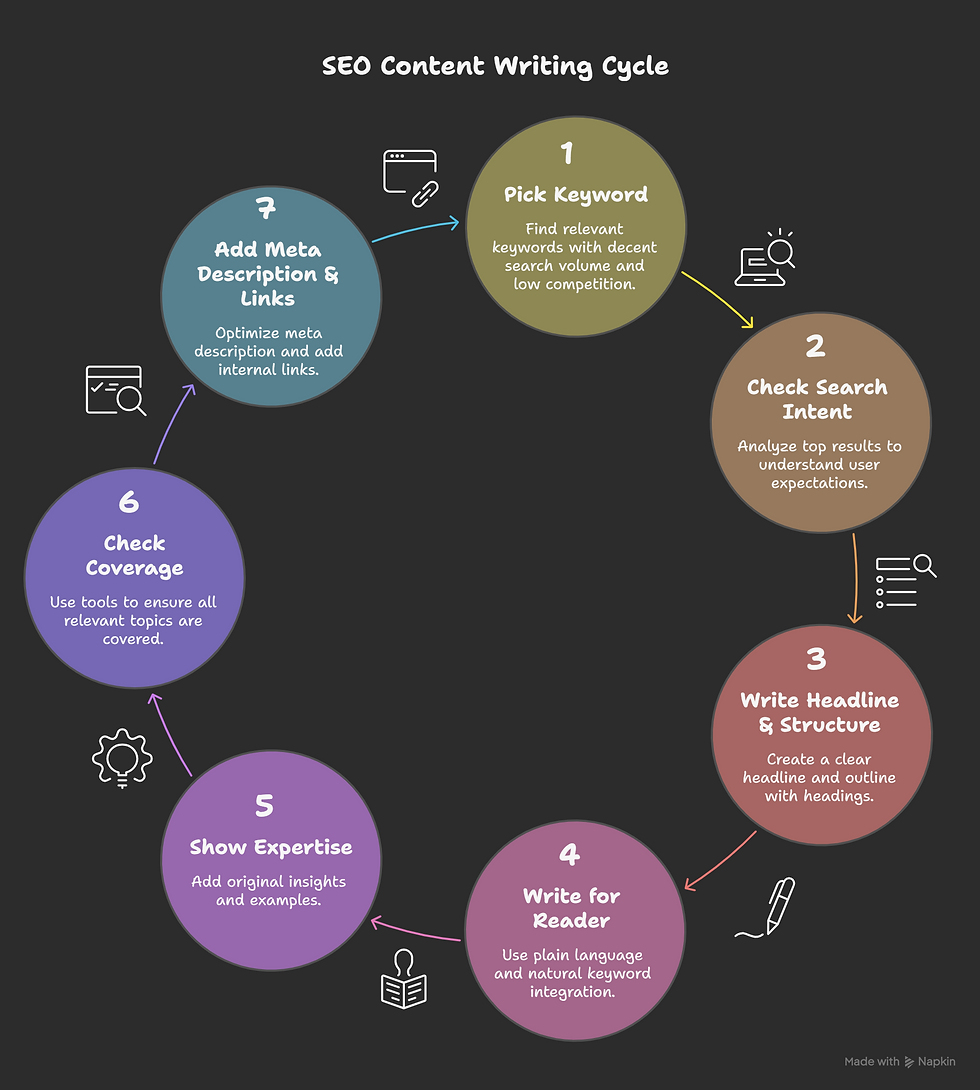
The single most important step in this list is the second one — checking search intent before writing. Most content that does not rank fails at this step. The keyword might be right but the content format is wrong, and Google simply will not show it to people searching for something different from what you wrote.
Do not try to write the perfect article on the first draft. Write a complete draft, then improve it. A published imperfect article can be updated and improved. A perfect article that never gets published ranks for nothing.
Common Mistakes to Avoid When Writing SEO Content
Mistake to Avoid | Why It Hurts Your Results |
Stuffing keywords in unnaturally | Google is smart enough to detect forced keyword use, and it makes your content unpleasant to read. Write naturally and use your keyword where it fits, not everywhere you can fit it. |
Writing without checking search intent first | If your content does not match what the searcher actually wants, Google will not show it, no matter how good the writing is. Always search the keyword before writing. |
Copying and rephrasing what already ranks | Google has no reason to prefer a copy of content that already exists. Add something original, your experience, your opinion, a real exampl, or you are just adding noise to the internet. |
Ignoring your existing content | Most sites have old posts that used to rank and have dropped, or posts that rank on page two with a small update. Refreshing these is often faster and more effective than writing something new from scratch. |
Writing for Google, not for people | Over-optimised content that sounds robotic or unnatural drives readers away quickly. Google measures how long people stay on your page, if they leave immediately, your ranking drops. |
Publishing without a meta description | Leaving the meta description blank means Google chooses one for you — usually a random sentence from the page that does not encourage anyone to click. Write your own, every time. |
Not adding internal links | Every article you publish should link to at least two or three other pages on your site. Internal links help Google understand your site structure and keep readers engaged with more of your content. |
Tools for Writing SEO Content in 2026
You do not need a big budget or a technical background to use these tools. Most have free versions that are more than enough to get started. Here is what each one does and where it fits in your writing process.
Tool | Best For | Pricing | How It Helps Your Content |
Google Search Console | Seeing which searches bring people to your site and spotting pages that need updating | Free | Shows you exactly which keywords your pages rank for and where you are losing clicks — the most important data source for content decisions |
Ahrefs | Finding keywords to write about and checking what your competitors rank for | From $129/mo | Keyword Explorer shows search volume, difficulty, and click data; Content Gap finds topics your competitors rank for that you do not |
Semrush | Keyword research, topic ideas, and tracking your rankings over time | From $139.95/mo | Topic Research tool generates content cluster ideas; Position Tracking shows whether your articles are moving up or down in rankings |
Surfer SEO | Checking your content covers all the right topics and terms before you publish | From $89/mo | Content Editor scores your article in real time against top-ranking pages and shows exactly which terms and entities are missing |
ChatGPT / Claude | Drafting outlines, generating FAQ questions, improving clarity, and checking coverage | Free–$20+/mo | Use it to generate a first draft structure, brainstorm headings, or check whether your article has missed any important subtopics |
Google Docs | Writing, sharing, and collaborating on your content before publishing | Free | Simple, shareable, and integrates with Surfer SEO's Chrome extension — the most practical writing environment for most teams |
Yoast SEO / Rank Math | Adding meta descriptions, title tags, and schema markup inside your CMS | Free / Paid upgrades | Both WordPress plugins guide you through on-page optimisation and let you add FAQ schema in a few clicks — no coding required |
If you are just starting out, you only need three tools: Google Search Console (free), Google Docs (free), and either Yoast SEO or Rank Math (free). These three alone give you the data, the writing environment, and the on-page optimisation you need to publish properly structured, search-ready content.
Add Ahrefs or Semrush when you are ready to actively research new keywords and track your rankings. Add Surfer SEO when you want to go deeper on content optimisation and make sure every article you publish is as complete as the competition. ChatGPT and Claude are most useful as thinking partners, for generating outlines, spotting gaps, and speeding up the drafting process.
Why Good SEO Content Still Matters in 2026
It brings you traffic you do not have to pay for. Paid ads stop the moment you stop paying. A well-written article that ranks on page one keeps sending visitors to your site for months or years without any ongoing cost. Think of it like owning a shop on a busy street versus renting a billboard — one is an asset, the other is an expense.
The number one result still gets a huge share of clicks. Even with AI Overviews appearing in roughly 1 in 6 searches and Google AI reaching around 2 billion monthly users, the number one organic result still captures around 34% of desktop clicks. That is a significant share of attention for any topic where your business has genuine expertise.
Long-tail content reaches people at exactly the right moment. 70% of all Google searches contain three or more words. These longer searches come from people who know what they want — and are much closer to making a decision. A small business that writes detailed, specific content for its niche can consistently outrank larger competitors on the searches that matter most to their customers.
It builds trust with your audience before they even contact you. When someone finds your article, reads it fully, and comes away with genuinely useful information, they remember your brand. They are far more likely to come back when they are ready to buy — and far more likely to recommend you to someone else. Good SEO content is relationship-building at scale.
Updating old content is one of the fastest wins available. Most websites have articles sitting on page two or three of Google that could reach page one with some targeted improvements. Adding new information, improving the structure, filling content gaps, or refreshing outdated stats can move a page up in rankings within weeks — without having to write anything from scratch.
AI has raised the quality bar, not lowered it. AI tools have flooded the internet with mediocre, generic content. Google has responded by getting better at detecting and deprioritising it. This means original, well-written, genuinely useful content stands out more than it did three years ago — not less. Good SEO content is a competitive advantage, not a commodity.
What SEO Content Looks Like in the Future
As SEO content continues to evolve, the most important shift is already underway: Google is getting better and better at identifying whether content was written by someone with real experience, or assembled from other sources without adding anything new. The bar for what counts as genuinely helpful is rising every year, and that is a good thing for anyone who takes the time to write properly.
Practitioners who invest in building real topical authority now, by publishing comprehensive, well-structured content on the topics they genuinely know, are building a compounding asset. Each article that earns a ranking also builds domain authority, which makes the next article easier to rank. The gap between sites that have invested in content quality and those that have not will widen significantly over the next two to three years.
The rise of AI search tools like Google AI Overviews and Perplexity AI adds a new dimension. These tools cite sources , which means your content can earn visibility inside an AI-generated answer even when a user does not click through to your site. The same signals that help you rank on Google (authority, clear structure, comprehensive coverage, trusted authorship) are the signals that get you cited by AI. Writing good SEO content and writing AI-citation-ready content are, increasingly, the same thing. Search Engine Journal's content marketing coverage tracks how these requirements are developing in real time.
The fundamentals will not change. Write something genuinely useful. Structure it clearly. Show that you know what you are talking about. Keep it up to date. That is what has always worked , and it is what will keep working regardless of what Google's algorithm does next. For the automation tools that help you produce this kind of content consistently, see AI for SEO: 10 Practical Ways to Use Artificial Intelligence in Your SEO Workflow. /html
FAQs — Frequently Asked Questions
1. What makes content rank on Google in 2026?
Google ranks content that best matches what the searcher is actually looking for. That means three things above all else: matching the intent behind the search (what type of content the person wants), covering the topic completely enough to answer every reasonable follow-up question, and demonstrating real expertise through named authors, original insights, and credible sourcing.
Keyword density, word count targets, and technical tricks matter much less than they used to. If your content is the most genuinely helpful answer to a search query,
Google will find a way to rank it.
2. How long should SEO content be?
There is no magic word count. The right length is however long it takes to fully answer the question, no more, no less. The best way to judge this is to look at what is already ranking for your target keyword and match the depth of those pages.
For detailed guides and comparisons, 1,500 to 3,000 words is common. For specific how-to questions with clear answers, 800 to 1,200 words may be enough. Adding padding to hit a word count target makes content worse, not better, Google can detect when content is thin and repetitive even if it is technically long.
3. How do I find keywords to write about?
Start with Google Search Console if you already have a website, it shows you what searches are already bringing people to your site and where you have opportunities to improve. For finding new topics, Ahrefs and Semrush both have keyword research tools that show search volume and competition level. For a free option, type your topic into Google and look at the 'People also ask' and 'Related searches' sections at the bottom of the page, these tell you exactly what questions real people are searching around your topic.
4. What is E-E-A-T and do I need to worry about it?
E-E-A-T stands for Experience, Expertise, Authoritativeness, and Trustworthiness. It is Google's way of deciding whether a source is credible enough to show to searchers. In practice, it means putting a real author name on your content, including a short bio that explains why that person is qualified to write about the topic, citing credible external sources, and adding original insights that come from real experience.
You do not need to be famous or have a long list of credentials. A genuine first-hand perspective on your subject area is enough to demonstrate E-E-A-T on most topics.
5. Should I use AI to write my SEO content?
AI tools like ChatGPT and Claude are useful for drafting outlines, generating FAQ questions, improving sentence clarity, and checking whether your article has missed any important subtopics. Where they fall short is in providing genuine expertise, original experience, and accurate specific facts, all of which Google increasingly rewards.
The most effective approach is to use AI to speed up the parts of writing that are mechanical (structure, formatting, first drafts) while making sure a human with real knowledge adds the original insights and reviews everything before it is published. AI-generated content that is published without expert review and editing tends to be generic, and generic content does not rank.
6. How do I optimise old content that has stopped ranking?
Start by opening Google Search Console and finding pages that used to get impressions but have dropped off, or pages that are stuck on page two or three. Then search the target keyword to see what is currently ranking and compare it to your existing page.
Common improvements include: adding new information that was not available when you first wrote the article, expanding sections that are thinner than what the competition covers, adding FAQ sections with schema markup, improving the headline and meta description, and adding internal links from newer articles back to the older one. These updates can move a page significantly within a few weeks.
7. How long does it take for SEO content to rank?
New content typically takes three to six months to rank on page one for competitive keywords sometimes longer. For less competitive long-tail keywords, you can see movement in four to eight weeks.
The timeline depends on how established your website is, how competitive the keyword is, how good your content is compared to what is already ranking, and how many other sites link to your page. Updating existing content that is already indexed and partially ranking is almost always faster than waiting for a brand new page to earn authority from scratch.
8. Do I need to know technical SEO to write content that ranks?
No. The core of good SEO content, writing something genuinely helpful, structuring it clearly, using your keyword naturally, and showing expertise, does not require any technical knowledge. The technical basics (meta descriptions, schema markup, internal links) can be handled with free tools like Yoast SEO or Rank Math inside WordPress, without touching any code. You only need to think about more technical SEO (page speed, site architecture, crawl errors) once you have strong content in place. Get the content right first, the technical layer can be added and improved later.
Next Steps | Engage With Us


This blog does a great job explaining how SEO content is evolving in 2026 and why user focused writing matters more than simply adding keywords. The emphasis on search intent, expertise, and useful structure makes the advice practical for both beginners and experienced writers. It also connects well with academic content creation, where research journal publication depends heavily on clarity, originality, and presenting information in a way that truly helps readers understand the topic.